Scope Creep Starts Before Development Does: How to Scope Your App the Right Way 🚧

If your app project has drifted off plan, you are in very common company, and it is rarely anyone's fault. Scope creep usually starts before development does, with a plan that was a little too vague.
So how do you stop scope creep before it starts? Write down your core goal and be organized and complete with your communication to your development team or cofounder.
What Is Scope Creep, and Why Does It Happen?
Scope creep is what happens when the list of things you are building keeps growing after the project has started, without the budget or timeline growing to match. It usually sounds harmless: "Can we also add a chat feature?" or "While you're building messaging, can it send a text message too?" Founders are excited and learning as they go, and developers want to say yes. Most of the time the real cause is one of these:
Vague requirements, like "a simple login" that means something different to each person.
Unspoken assumptions, such as the founder expecting an admin dashboard that was never discussed.
"While you're at it" requests that each seem small but add up fast.
Clear communication is the other half of the fix. Our article on why effective communication is the number one skill in the age of vibe coding shows how to describe what you want so that you and your developer picture the same thing.
Planning and communication pay off. PMI's 2023 report found that organizations prioritizing "power skills" (communication and collaboration) reported scope creep in only 28 percent of their projects (source).
What Goes in a Scope Document?
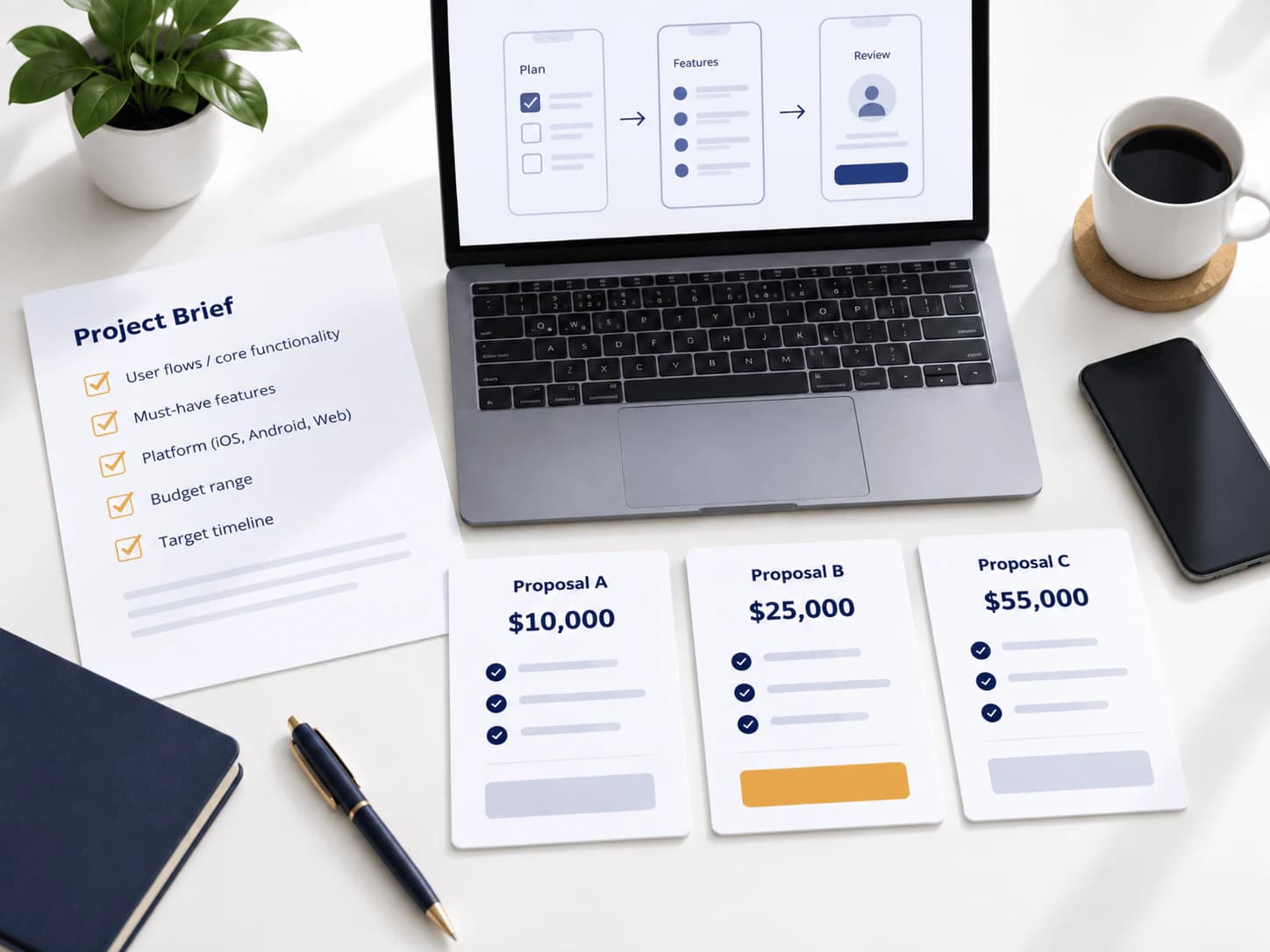
Your scope document does not need to be long or fancy. A clear few page document is plenty. Here is what to include:
- Project goal and target users
- Must-have, should-have, and later feature lists
- Platforms and devices (iPhone, Android, web)
- Milestones, phases, for the features above
- Rough timeline
- Rough budget
If you are about to request quotes, our checklist on what to send a developer before you ask for a quote pairs well with this document.
How Do You Pick One Core Goal?
Before you write a single feature down, answer three questions in plain language: What problem does this app solve? Who is this app for? What does success look like in the first six months? Then boil it down to one sentence, for example: "Help local gym members book classes without calling the front desk." When a new idea comes up later, hold it up against that sentence. If it does not support the goal, it is a candidate for later.
How Do You Sort Features into Must-Haves vs Nice-to-Haves?
List every feature you can think of, then put each one in a bucket:
Must have: the app does not work, or does not test your core assumption, without it.
Nice to have: valuable, but the first version can launch without it.
Later: good ideas that could belong in a future release.
Be strict. Most first versions only need a handful of must-haves. Everything else still has a home, just not in version one.
How Do You Write a User Story?
A user story is one sentence that describes what a person can do and why: "A customer can open my app and reserve gym equipment without speaking to anyone." Compare a vague requirement with a clear one.
- Vague: "Users can manage their appointments."
- Clear: "A customer can reschedule an appointment up to 24 hours ahead so that they do not have to call us."
Stories like this give you and your developer the same picture of the feature, with no jargon. They also make estimates far more accurate, because a developer can price what the story says instead of guessing what "appointment management" means.
Why Should You Write Down What Is Out of Scope?
This is the most overlooked step, and one of the most powerful. Write down, in plain words, what is not included: "No Android version in phase one," "No in-app payments at launch," or "No admin reporting dashboard." An out-of-scope list turns unspoken assumptions into visible decisions. Many arguments about scope come down to "I thought that was included." A written "not included" list ends that argument before it begins.
How Does a Lean Mindset Keep Scope Small?
The best defense against scope creep is a way of thinking, not just a document. It comes from the Lean Startup approach, which we have written about in what the Lean Startup is and how it can save you thousands. Instead of building everything you can imagine, build the smallest version that tests your biggest assumption. Put it in front of real users, learn what they actually do, and then decide what to add. Lean Startup calls this the build, measure, learn loop.
That gives you a built-in filter. Every feature has to earn its place by answering one question: "Will this help us learn something important about our customers?"
This is the same thinking behind the MVP vs. full product decision. A lean mindset does not mean building something cheap or half-finished. It means being deliberate about what goes in, and honest about what can wait.
How Do You Phase the Work?
Break the project into milestones and releases rather than one giant launch. A first release with your must-haves, then a second with your should-haves, keeps each stage small enough to estimate well and review honestly. Keep a "parking lot" for good ideas that come up midstream. Nothing is rejected, nothing is lost, and nothing derails the current phase. Many founders find that several parking lot items stop seeming important once real users start giving feedback.
How Do You Handle Changes Without Losing Control?
Change is not the enemy. New information is the whole point of building lean. The problem is unmanaged change. Agree up front on how new ideas get handled:
- The idea is written down as a short request.
- The developer estimates the effect on cost and timeline.
- You approve it, swap it for something else, or move it to the later list.
It also helps to understand how your pricing model handles change. With a fixed price, additions are typically priced as separate change orders. With hourly or time-and-materials billing, additions flow straight into the bill. Neither is wrong, but you should know which one you are in before the first request comes up.
What Are the Warning Signs Your Scope Is Slipping?
Keep an eye out for these signals during the project:
- The feature list keeps growing, but the deadline has not moved.
- Requests are described as "quick" or "small" without an estimate.
- Nobody is sure who approved a particular change.
- The team is debating what a feature was supposed to do.
- You keep thinking of features that would be "great to have" before launch.
If two or more of these sound familiar, pause and revisit your scope document before more work gets built on shaky ground.
Want Help Scoping Your App?
Scope creep is not inevitable. A focused goal, a lean first version, and a written plan for handling change will protect your budget, your timeline, and your relationship with your development team. If you would like a second set of eyes on your feature list, contact us for a free consultation. We will walk through your idea in plain English and help you decide what belongs in version one, whether you are planning mobile app development or web app development.